2.2.1 Two ships are involved in a ship-ship collision analysis: a striking ship
and a struck ship. It is assumed that, as illustrated in Figure 1.2.1 Illustration of ship-ship collisions, the struck ship is to be collided by a same sized striking
ship.
2.2.2 The collision scenario is that the striking ship impacts the struck ship at the
location where the fuel tank is located. The struck ship is assumed to be stationary
before collision and the striking angle between striking and struck ship is assumed
to be 90 degrees in the horizontal plane.
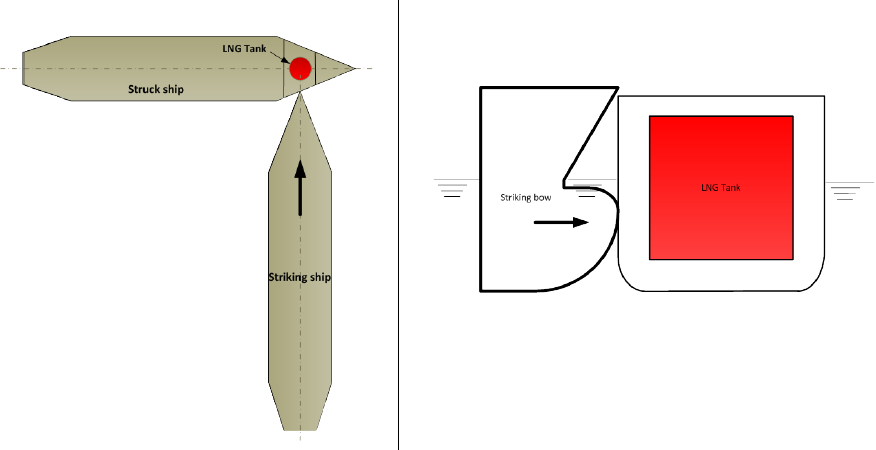
Figure 1.2.1 Illustration of ship-ship collisions
2.2.3 Three cases of loading conditions are considered as illustrated in
Figure 1.2.2 Three collision cases of
loading conditions:
- Case 1: Both striking ship and struck ship are fully loaded
(or both are in ballast conditions)
- Case 2: Striking ship is in ballast condition and struck ship
is fully loaded
- Case 3: Striking ship is fully loaded and struck ship is in
ballast loading condition.
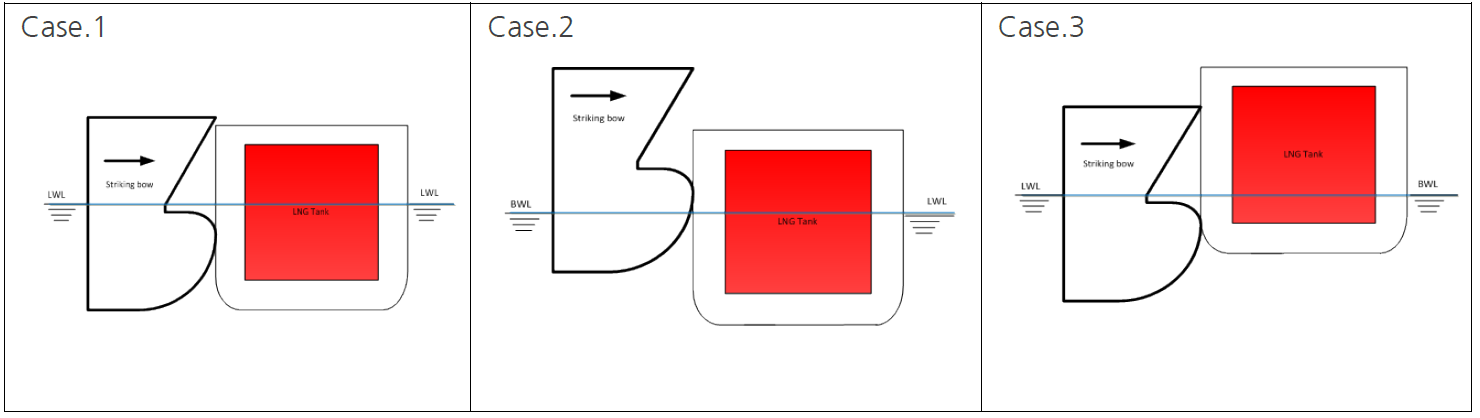
Figure 1.2.2 Three collision cases of
loading conditions
2.2.4 It is assumed that the striking bow is rigid and all collision energy is absorbed by
the struck ship and in this case the worst damage to the struck ship can be
determined.
2.2.5 Two struck ships are to be assessed: one is called the Reference Ship and the other
the Target Ship. Both struck ships are assumed to be collided by the same striking
ship with the same collision scenarios.
2.2.6 The Target Ship refers to the new design where the fuel tank location does not meet
the Rule requirement and the tank boundaries are too close to the ship side.
2.2.7 The Reference Ship is a ship which meets the current minimum Class Rule requirements.
It is a similarly sized ship as the Target Ship, and constructed in single hull and
without any specific strengthening (e.g. ice strengthening).
2.2.8 The Reference Ship is subjected to a collision directly into the side
shell at the location where the fuel tank is located. The rigid striking bow
penetrates to B/5 from the struck ship side. The collision energy absorbed
(Eref) by the Reference Ship is calculated.
2.2.9 The Target Ship is subjected to the same collisions. The extent of
penetration into the ship and the absorbed energy (Ecrit) at the critical
penetration (Bcrit), e.g. just before reaching the boundary of the fuel
tank (as illustrated in Figure 1.2.3 Illustration of absorbed energy of reference ship and target ship), is calculated.
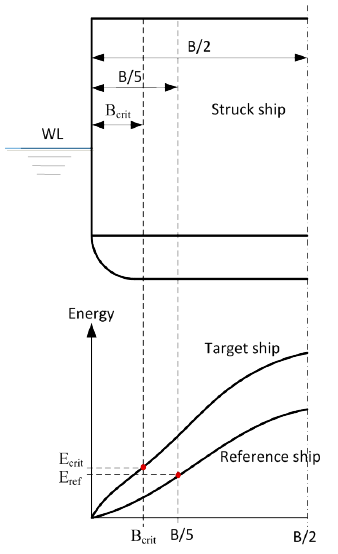
Figure 1.2.3 Illustration of absorbed energy of reference ship and target ship
2.2.10 Collision energies for the three cases of loading conditions, as
illustrated in Figure 1.2.2 Three collision cases of
loading conditions, are calculated based on the above routines. The
absorbed energy weighted from the three collision cases is to be used for comparison
and determined from the following:
2.2.11 If the Target Ship absorbs the same amount of energy or more at the critical
penetration (Bcrit), then the equivalence of strength to resist collision
damage is demonstrated. That is:
2.2.12 Simplified analytical methods as described in the following Section, or alternative
methods subject to Lloyd’s Register’s agreement, may be considered in use for the
collision damage assessments.